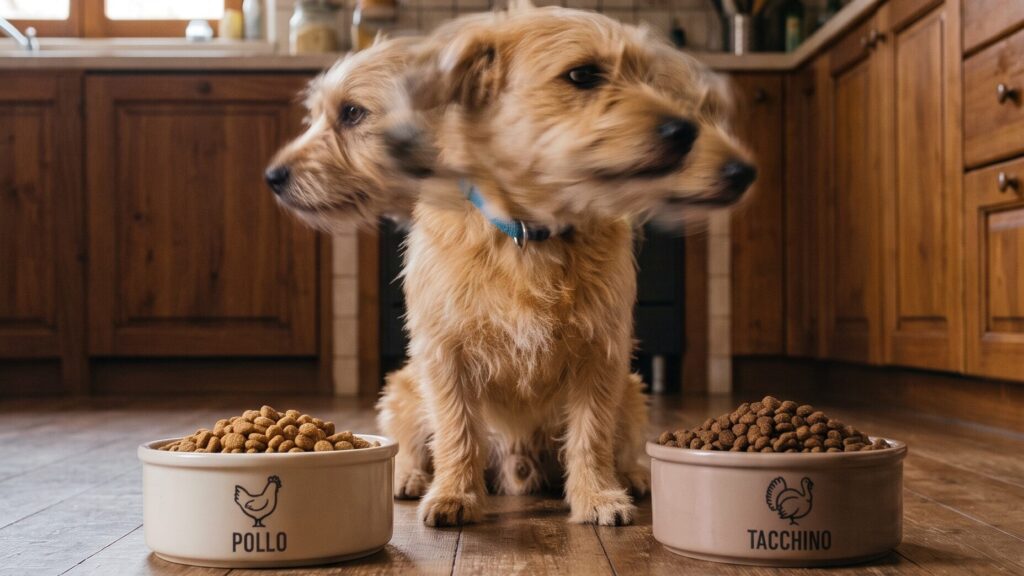
There's no one-size-fits-all answer for all dogs. Chicken, turkey, and duck contain proteins that the immune system can recognize as similar, so turkey isn't automatically considered safe, nor should it be automatically avoided. The answer for your dog comes only from a consultation with your veterinarian.
Your veterinarian told you that chicken might be the cause.
You get home and think: all right, I'll give my dog turkey instead.
It's an understandable reaction, but it can cost you months.
But if your dog is allergic to chicken, can it eat turkey?
A few words before moving on
We make cricket-based kibble. But we're not here to tell you that chicken is bad.
If your dog eats chicken, beef or fish and is fine, coat in order, belly in order, no scratching, non c’è nessun motivo di cambiare.
A good food made with chicken real, from a supply chain that treats animals well, is a good food. Period.
Quello contro cui siamo è un’altra cosa: the poorly made products, and the words used to avoid being understood.
This article is meant to give you clarity. Even when clarity doesn't sell anything.
One thing to know first: "chicken" doesn't say it all.
Sull’etichetta, la parola "chicken" tells you the species. Non ti dice quale parte dell’animale, e non ti dice quanta ce n’è.
It seems like a small detail. It's not: if you're trying to figure out if food is responsible for your dog's itching, and you don't know exactly what's in the bowl, all your hard work might be for nothing.
It's a big topic, and we'll devote an article all its own. Set it aside for now.
Why Chicken and Turkey Are Related
The immune system doesn't read animal names. It reads the shapes of proteins.
And in chicken, several proteins that dogs can recognize have been identified: seven major allergens and one minor allergen. Non c’è una sola proteina da evitare, ce ne sono diverse, e alcune assomigliano a proteine presenti in altri volatili.
In a 2017 study they analyzed 40 blood samples of dogs with antibodies against chicken.
All the samples reacted to chicken. Il 97% riconosceva anche il tacchino, e il 97% anche l’anatra.
This seems like the definitive answer. It isn't, and it's worth understanding why.
That 97% This doesn't mean that 97 out of 100 dogs with chicken allergies will get sick if they eat turkey.
This means that, in the 40 samples examined, the antibodies also recognized turkey proteins. in a test tube.
And an antibody that recognizes a protein in the laboratory is not a dog that gets sick after eating.
The first is immunological. The second is clinical. The literature currently documents the first very well, the second much less so.
So no one can tell you in advance what's going to happen in your dog's bowl. Anyone who tells you for sure is guessing.
«Then I'll give him something further away»
È il pensiero successivo, ed è comprensibile. Se il tacchino è troppo parente, si va sull’anatra. Oppure sul pesce.
It doesn't work like that.
Cross-recognition was also observed here in the laboratory. between chicken and fish, two animals that apparently have nothing in common. Nine proteins involved have been identified. (Again: Test tube recognition does not prove that the dog will get sick.)
La sola specie di origine non permette di prevedere con certezza se il cane tollererà quell’alimento.
And that's why there's no ranking of birds from safest to least safe.
Se la trovi da qualche parte, se l’è inventata qualcuno.
What if it wasn't even chicken?
This is the question that almost no one asks.
Among the dogs in which a food was confirmed to be the culprit with a reintroduction trial, the first on the list It's not chicken: it's beef, which occurs in about a third of cases. Then come dairy products. Chicken comes second.
It should be read for what it is: it is not a snapshot of all the dogs in the world, it is the distribution among the dogs studied and already diagnosed.
But he does say one thing, and it's useful: The most likely culprit isn't always the one you think of first.
And not because beef is bad.
Because it is the most used protein in kibble, therefore it is the one that dogs encounter first, and for the longest time.
When the vet chooses a protein never eaten before
Don't change at random. Every blind attempt is a time when the dog continues to be like this, and when the picture gets confusing.
Reconstruct what he actually ate. It's not just kibble: treats, leftovers, and a treat to help him swallow his medicine. A protein that seems new to you might not be new to him.
In the end, Ask your vet for a diet.
Usually he will tell you that there are two simple ways: a protein that the dog has never encountered, or a hydrolyzed diet, where proteins are broken into fragments small enough not to be recognized.
Su questa seconda strada c’è una cosa da sapere: conta quanto è spinta l’idrolisi.
In a review of controlled studies, up to half of the dogs involved had worsening after hydrolysates partial derived from foods to which they were already sensitive.
It's not necessarily a wrong path, it's a path where the degree of workmanship makes the difference.
Ed è un’altra ragione per cui la scelta è del veterinario.
On the first road, however, the difficulty is actually finding it.
In a market where chicken, beef, lamb and fish are everywhere, "never eaten before" It's a rarer condition than it seems.
Nutrinsect Intolerance Diet was born for this scenario.
It's a complete dietary food, with Cricket Protein and Fava Bean formulated by Doctor Davide Galaverna, not a re-adapted generic food.
👉 Discover the features of Nutrinsect Intolerance Diet 👉 Leggi l’approfondimento: perché cambiare marca spesso non basta
The confirmation, in any case, comes at the end.
Se il cane sta meglio, si rimette l’alimento di prima e si guarda se il fastidio torna.
È questo passaggio che trasforma un’impressione in una risposta.
Un’ultima cosa che vale la pena sapere: Blood tests do not resolve the issue.
Their accuracy for food reactions varies, and they do not replace the path just described.
Frequently Asked Questions
My dog is allergic to chicken; can he eat turkey? It can't be considered automatically safe. Cross-reactivity between chicken, turkey, and duck extracts has been documented in the laboratory: antibodies recognize them as similar. However, this doesn't allow us to predict whether an individual dog will become ill after eating it.
Are hydrolyzed kibbles always safe? No. L’idrolisi riduce la possibilità che le proteine vengano riconosciute, ma dipende da quanto è spinta: gli idrolizzati parziali possono ancora dare problemi in cani già sensibili a quell’alimento.
L’anatra è più sicura del tacchino? The literature doesn't allow us to establish a safety ranking among poultry. No poultry meat is predictably "further away."
If I change species, do I definitely have a new protein? No. Proteins from different animals can be similar. Cross-reactivity has even been documented between fish and chicken.
Is there a blood test that tells me this? L’accuratezza dei test sierologici per le reazioni alimentari nel cane è variabile, e non sostituiscono la dieta a eliminazione seguita dalla reintroduzione.
Can I do an elimination diet myself? È preferibile di no. Serve scegliere l’alimento giusto, tenere il percorso pulito e interpretare il risultato — e quella parte è del veterinario.
What does “never eaten protein before” mean? Una fonte proteica che non fa parte della storia alimentare del cane. Serve a ridurre la probabilità che sia già stato esposto a quell’ingrediente. Non significa che sia impossibile da riconoscere.
Where does the information in this article come from?
All clinical statements on this page are from published, peer-reviewed veterinary literature.
- Olivry T., Bexley J., Mougeot I. — Extensive protein hydrolyzation is indispensable to prevent IgE-mediated poultry allergen recognition in dogs and cats, BMC Veterinary Research, 2017 — link
- Olivry T. et al. — Identification of major and minor chicken allergens in dogs, Veterinary Dermatology, 2022 — PubMed
- Bexley J., Kingswell N., Olivry T. — Serum IgE cross-reactivity between fish and chicken meats in dogs, Veterinary Dermatology, 2019 — PubMed
- Mueller R.S., Olivry T., Prélaud P. — Common food allergen sources in dogs and cats, BMC Veterinary Research, 2016 — PubMed
- Mueller R.S., Olivry T. — Can we diagnose adverse food reactions with in vivo or in vitro tests?, BMC Veterinary Research, 2017 — PubMed
- Olivry T., Bizikova P. — A systematic review of the evidence of reduced allergenicity and clinical benefit of food hydrolysates in dogs, Veterinary Dermatology, 2010 — PubMed
Se un’informazione non l’abbiamo trovata in una fonte di questo tipo, non l’abbiamo scritta.
Nutrinsect.
To nourish is to protect.
⚠️ This article is for informational purposes only and does not replace a veterinary visit.
Prima di cambiare l’alimentazione del tuo cane o di intraprendere qualunque percorso è opportuno parlarne con il tuo medico veterinario. È l’unico che può visitarlo e dirti cosa ha davvero.